
Free Click & Collect
Within One Hour

Reading time: 4 minutes
Property owners across the UK continue to face the challenge of paying high amounts for their energy bills.
In fact, a research briefing published in the House of Commons Library has revealed that in November 2025, energy prices were still significantly above the levels seen prior to summer 2021 – the start of the nation’s energy crisis.
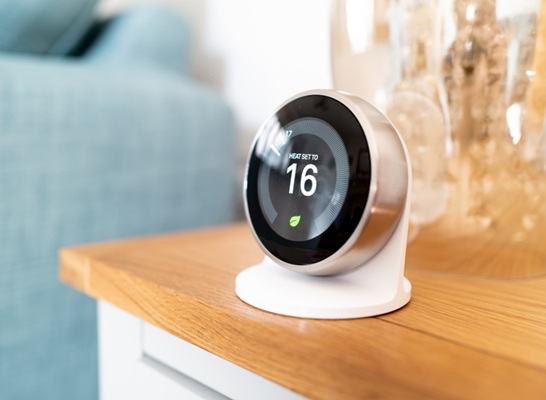
Smart heating controls refer to devices which allow property owners to become more connected with the boiler found within their house.
These controls are part of the smart home revolution, which has seen properties and their traditional systems becoming much more technologically advanced.
When it comes to how smart heating systems in particular work, these enable a property’s heating system to connect to Wi-Fi so that it can be controlled via an app found on a smartphone or tablet device.
Smart thermostats are a popular product within a smart heating system range. There are other handy devices within this collection though, including smart radiator valves. These can be used to control the temperature output of each radiator fitted in a property.
There are several key reasons why many households throughout the UK are investing in smart heating systems.
As mentioned earlier, many property owners are trying as much as possible to bring their energy bills down. Smart heating controls can help people to achieve this, as they can monitor the energy they are using through an app and then research ways to reduce instances where energy is being wasted.
Another benefit is that smart heating controls provide property owners with more flexibility than traditional systems. Heating can be controlled remotely from a smartphone, for example, even when the user is not in their property.
This is perfect when people want their houses to be warm when they return from work or a social outing when it is chilly. However, it also proves very handy if someone has the awful feeling that they have left their property standing empty with their heating still on.
The ‘smart’ aspect of these devices is highlighted even further by the fact these technologically advanced controls can automatically adjust a property’s heating settings by studying the time it takes for rooms to warm up.
Focusing in on smart thermostats, a convenient feature found on these systems is geofencing. Designed to set up a virtual boundary around a desired area (a property and its direct surroundings, for instance), this function can see a house’s heating switch on and off automatically whenever someone with a corresponding smartphone enters or leaves the area.
There will be times where property owners can fit smart heating controls themselves. Plug-in-and-play systems and battery-powered smart radiator valves are usually simple to set up around a property.
However, your services as a professional installer or certified engineer will be required whenever a property’s electrical and heating systems need to be altered or worked on.
Tasks you may be requested to carry out include:
Establishing safe connections of smart heating controls to modern boilers, which include combi, S-plan and Y-plan models.
Hardwiring a mains-powered smart thermostat to a property’s boiler.
Setting up complex wiring arrays around a property’s heating system.
Working on any hot water controls or unvented heating systems, due to the legal safety risks attached to these.
Ensure you have the skills to complete all this work to be in a fantastic position to be helping more property owners to transform their houses into smart homes.
Looking to become more of a specialist in fitting smart technology into UK properties? Stand out from your competition by also reading our ultimate builder’s guide to smart homes.