
Free Click & Collect
Within One Hour

Reading time: 4 minutes
During the 2024/25 storm season alone, the UK was hit with five named storms between October 2024 and January 2025. This could have disrupted your work for up to ten days, depending on which part of the country you ply your trade.
You also have less daylight hours to work in during the colder months, to the point where you could be completing a job in darkness if you start before 8am or finish after 4pm during December.
While no-one can be completely accurate when predicting the weather, forecasters often do get it right when they report that a storm is approaching.
If you plan out your own work in the trade, you should be regularly tuning into weather reports and then working out which jobs you can do safely and efficiently depending on the conditions.
You will not want to be doing any tasks on surfaces which become slippery when wet if there is a heavy rainstorm in the forecast, for example, while indoor jobs should be planned in anytime a thunderstorm looks to be looming on the horizon.
Coordinate your work schedule to suit the weather and you will be able to enjoy less delays with jobs throughout the autumn and winter months – to the satisfaction of your clients and giving you the edge over your competition.
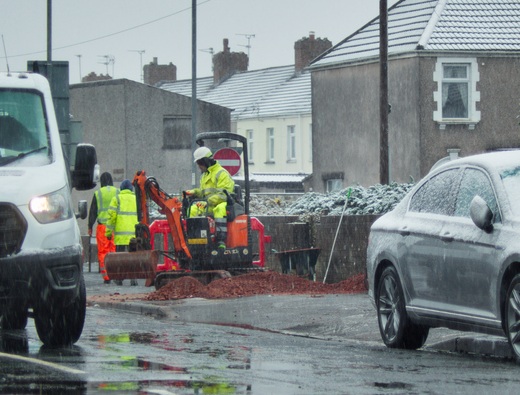
If you cannot avoid working in bad weather, make sure you wear, or at least have to hand, the necessary safety gear for the conditions.
Here’s a handy checklist of items to always put on when the weather is wet, blustery or cold:
A hard hat complete with chinstrap, with a woolly hat or thermal liner also worn under the hard hat to help retain body heat when it is very cold.
A safety harness which is connected to an anchored fall arrest system (if working at height).
Thermal base layer clothing, as well as those which cover the neck.
Waterproof clothing as an outer layer to your normal work clothing.
Work boots which are durable and designed with slip-resistant soles.
As well as protecting yourself when completing a job outside when the weather is not the best, make sure you have also stabilised any ladders, lifts and scaffolding you will be using by placing sand bags and ballast weights around them.
No matter how much you plan your work around the weather, there may be times when conditions become so hazardous that you will have no choice but to halt the job until a storm passes.
You should instantly cease work in areas where there is a risk that objects can fall and cause injury, with the same precaution applied where temporary structures could collapse.
You could set up a job site radio around your working environment too. You will be able to tune this into a local radio station that regularly broadcasts weather information around you, so that necessary steps can be taken if you hear that conditions are about to get worse.
Delays to a job can be frustrating, but work can take longer when you are battling the elements – not to mention putting you and others at risk.
Even when the weather is calm, there will be times during the autumn and winter when you are needing to proceed with a job at night due to the shorter days.
Long dark nights present its own challenges to those in the trade, so stay safe by following these three rules:
Make high-visibility, reflective clothing an essential component of workwear on a site, so that tradespeople can always be seen.
Use site lighting to ensure all parts of a work site are always visible when completing a job.
Place dust extractors around a site as well, to limit the amount of dust that lingers during a project and causes decreased visibility (not to mention risks to a tradesperson’s health).
Looking for inspiration on the jobs to complete throughout the autumn and winter months? Read our latest ideas for big and small jobs to consider within our fantastic Trade Corner hub.