





Free Click & Collect
Within One Hour

Reading time: 8 minutes
This shift in fencing choices is being influenced by more than size and price. Customers may be thinking about how the space will be used, how visible the boundary is, how often the materials will need attention and whether the fence needs to work with other landscaping features.
For trade professionals, this creates an opportunity to guide the specification earlier. Composite fence panels, composite fence boards and fence screening can all support different project needs, but they should be chosen for the right reason.
Many fencing jobs now form part of a larger outdoor upgrade. You may be asked to complete a boundary fence as part of a patio project, refresh a tired garden area, create a screened storage zone or divide a communal space into more usable sections.
A fencing brief may now include:
Creating a stronger boundary line
Screening a practical area such as bins or storage
Dividing a garden or landscaped area into sections
Improving the look of an external space
Reducing the amount of future upkeep
Matching fencing with paving, turf, decking or planting
Working around changes in ground level
Allowing for gates, access points and returns
This does not mean every project needs a specialist system. In many cases, standard timber fence panels or feather edge fencing will still be suitable. The key is understanding when the brief has moved beyond a basic replacement.
Composite fencing is becoming a more common option where customers want fencing that looks consistent across the full run and does not need the same level of regular treatment as timber.
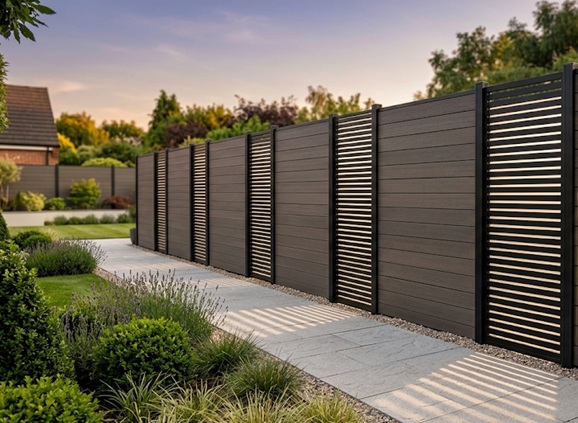
Composite fence panels can be useful for projects where a uniform finish is required. They may suit systems where boards are installed individually allowing the fence height or layout to be built up in stages.
For builders, composite fencing is worth discussing when the customers want a finished boundary that feels more planned and less temporary. It may be especially relevant on projects where the fencing needs to sit alongside new paving, decking, external storage or a wider landscaping project.
However, composite fencing should not be treated as a direct replacement for every timber fencing job. The system, posts, fixings and layout still need to suit the site conditions.
Garden screening and fence screening are being used in more ways than just covering an existing fence. They can help shape how an outdoor area works and how different parts of the space are viewed.
Screening may be used to:
Hide bin stores or service areas
Create separation around seating areas
Break up a long boundary line
Add coverage to side passages or returns
Divide communal gardens or shared outdoor spaces
Create a backing for planting areas
Improve the finish around commercial external areas
This makes screening more of a planning consideration than a finishing detail. If screening is added late, it may not have the right support points. Contractors should think about it at the same time as posts, fence height, access and ground level.
As fencing projects become more detailed, quoting may need to account for more than the number of panels required. Builders may need to allow for preparation, removal of existing materials, changes in level, additional posts, finishing trims, gravel boards, gates or screening sections.
A clear quote should consider:
The type of fencing being installed
Whether the project uses panels, boards or screening
Any site clearance required
Post spacing and fixing requirements
Ground conditions and excavation depth
Changes in level or stepped sections
Gates, returns and access points
Waste materials that need to be disposed of in the correct way
Delivery access and storage space on site
This helps avoid underquoting and makes it easier to explain why one fencing option may require more preparation than another.
Fencing choices should be discussed before materials are ordered. This is especially important when composite fencing panels, composite fence boards or fence screening are being considered, as different systems may have specific compatibility requirements.
Contractors should check:
Finished fence height
Total fence length
Exposure to wind
Soil and ground conditions
Boundary position
Planning or site restrictions where relevant
Whether gravel boards are needed
Whether the fencing needs to work with existing posts
Fixing method and product compatibility
Whether the project includes slopes or uneven ground
More solid screening or taller fencing can be more exposed to wind, so the supporting structure needs to be suitable. Posts and fixings should be chosen with the full fence system in mind, not only the visible panels or boards.
The materials required will depend on the specification, but fencing and screening projects may include:
Composite fencing panels
Composite fence boards
Fence screenings
Where different materials are being used together, check if they are compatible before installation. Different fencing systems are designed to work specifically with different posts, boards or fixings.
Changing fencing demand can create more detailed projects, but the basics still matter. A strong finish depends on good planning, accurate setting out and suitable materials.
Common issues include:
Choosing fencing based only on the finished look
Not checking whether existing posts can be reused
Forgetting to allow for gates or access points
Underestimating wind exposure on screened areas
Not allowing for changes in ground level
Mixing components from different systems
Leaving gravel boards until late into the job
Not checking delivery access before ordering
Failing to protect materials while stored on site
By raising these points early, contractors can help customers understand the practical side of the project and reduce the chance of delays.
Builders can respond to changing fencing demand by treating fencing as part of the wider external works plan. Rather than offering one standard option, it can help to explain where timber fencing, composite fencing and screening each fit.
This does not need to make the project more complicated. It simply means asking better questions at the start of the process and choosing the correct materials for how the area will be used.
For example, a boundary may need strong fence panels, while a bin store or seating area may only need screening. A property improvement project may need fencing that matches new paving or landscaping, while a practical service area may need something simple and easy to maintain.
This approach helps customers make a more informed choice and gives contractors a clearer basis for quoting and ordering materials.
Composite fencing is being considered more often because customers are looking for fencing options that offer a consistent finish and require less regular treatment than traditional timber fencing.
Garden screening can be used to cover boundaries, divide outdoor spaces, screen storage areas or improve the finish around landscaped sections.
Yes, they can be added to some existing fences, but the structure needs to be checked first. Extra screening can increase wind exposure, so posts and fixings must be suitable and secure.
No. Composite fencing and timber fencing suit different projects. Timber may be preferred for traditional finishes, while composite fencing may suit a more modern project where consistency and reduced upkeep are priorities.
Fencing demand is shifting because customers are using outdoor spaces in more varied ways. Builders may now need to think about boundaries, screening access, storage areas and landscaping finishes as part of the same project.
Composite fence panels, fence boards and screening can all support these changing requirements when they are specified correctly. For contractors, the main priority is to understand the project brief, check the site conditions and choose materials that suit the full fencing system.
As a builder’s merchant, Travis Perkins offers a range of fencing materials, composite fencing, fence panels, posts, fixings and landscaping products to support fencing and external works projects.