





Free Click & Collect
Within One Hour

Reading time: 5 minutes
Finding the right garden gate for a landscaping project is a decision that you shouldn’t take lightly. After all, these structures can improve both the aesthetic appeal and practical aspects of a property’s outdoor space.
These are the standard sizes of garden gates that you will decide between (with the width roughly the same but the height adjustable based on requirements), as well as where each is typically used:
3-foot by 3-foot garden gates – Often used as entrance gates to a property, where an open sightline to the house is preferred.
3-foot by 4-foot garden gates – These gates are usually used to finish off a decorative fencing arrangement around a property’s boundary.
3-foot by 5-foot garden gates – These act as a solid safety barrier around a property’s outdoor space, proving especially appealing for keeping children and pets safe when they are using a garden.
3-foot by 6-foot garden gates – Commonly used as a side or rear gate to a property, these are a great security option.
When measuring a garden gate, also take note that they often fall under permitted development rights. This means a property owner will not typically need to apply for planning permission when the gate is being installed within a property’s boundary.
These rules may differ when you are working in conservation areas, listed buildings or on gates to be placed next to a road, footpath, or public right of way though.
Read through our handy planning permission and building regulations guides if you are unsure if this will apply to your project. Alternatively, enquire with the local council where work is taking place.
Garden gates have several different names – here’s how to distinguish between each style:
Featheredge garden gate – Constructed using overlapping vertical timber boards that are tapered (thinner on one edge, thicker on the other). This creates a traditional, robust, and weather-resistant boundary.
Hit and miss garden gate – Boards are fixed alternately to the front and back of the supporting frame. This allows wind to pass through (reducing wind resistance), while maintaining privacy.
Overlap garden gate – This style of gate places individual wooden boards over each other in a horizontal manner, for a simple yet functional design that also provides a garden with a rustic feature.
Picket garden gate – A 3-foot by 3-foot gate, these decorative structures attach vertical spaced slats to horizontal rails in a way that light and views do not become obstructed.
Slatted garden gate – Parallel slats are arranged either vertically or horizontally on this gate style, with each slat evenly spaced so that light can pass through the gate for a clean, modern and yet private design.
Tongue and groove garden gate – These durable structures use wood planks cut in a way that sees a protruding feature on one edge (known as the tongue) and a concave feature on the opposite edge (referred to as the groove). Sometimes shortened to a T&G gate, property owners receive a gate with a clean and contemporary design with this style.
When selecting a garden gate, you will also have a decision to make about the choice of material so that the style, durability, and maintenance of the structure will suit your project.
Composite garden gates are designed to last and are low maintenance solutions. They often are more expensive upfront than garden gates made from other materials though.
Metal garden gates, whether built using steel or wrought iron, are very strong structures that add a decorative touch to a property’s outdoor space. Just take note that those with open metalwork will provide property owners with less privacy.
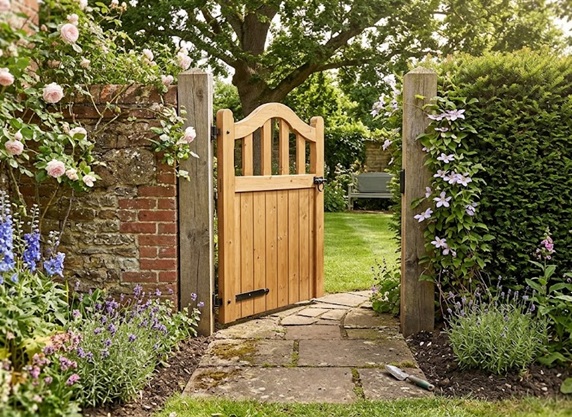
Timber garden gates present a property’s boundary with a structure that has a rustic and warm design. It is easy to paint or stain these gates too, though property owners will need to regularly maintain them so that they do not warp and rot.
Now that you know how to buy the right garden gate every time, check out our garden security ideas for advice on how gates and various other essential items can make a property more secure.