





Free Click & Collect
Within One Hour

Reading time: 5 minutes | Published 4 November 2026
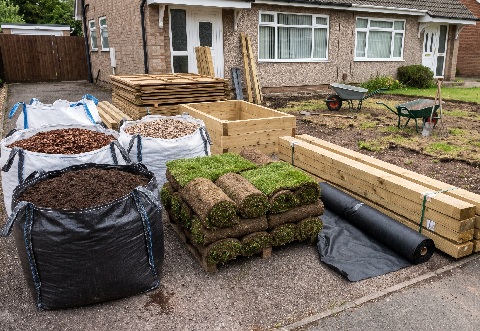
Lawn turf – for new grassed areas, laid onto prepared soil.
Artificial grass – a low-maintenance alternative to turf for year-round use across a range of landscaping applications; see our artificial grass installation guide for laying it on different surfaces.
Topsoil and compost – topsoil for building up or levelling ground and creating the growing layer beneath turf, seed or planting, and compost for improving existing soil and supporting planting in beds, borders and containers.
Bark chippings and garden mulch – for covering planted beds, retaining moisture and suppressing weeds.
Weed control fabric – a permeable barrier used under bark, mulch or decorative gravel.
Planters and raised beds – for defining planting areas above ground level.
Garden edging and log rolls – for defining lawns, beds and borders.
Timber sleepers – for raised beds, borders, steps, and suitable retaining or level-change features.
A typical landscaping scheme moves through several stages, often using more than one material type at each:
1. Prepare levels and growing areas. Assess the existing soil and add topsoil where the specification or ground condition requires it. Checking the depth and quality of the existing soil first can avoid ordering topsoil that isn't actually needed, or underestimating how much is required where the ground is poor.
2. Set out beds and boundaries. Edging, sleepers, planters or raised beds establish the different zones before planting and finishing materials go in.
3. Prepare for turf and planting. Compost can be worked into beds, while lawn areas need suitably prepared soil ready for turf or seed. Our lawn and turf groundwork guide and topsoil and compost buyers guide cover this stage in more depth.
4. Complete the surface finish. Turf can be laid once the ground is ready. Where weed control fabric forms part of the specification, install it before adding suitable bark, mulch or decorative finishes. Our guide to bark chippings and mulch goes further into laying and finishing.
Total area and required depth – coverage needed for topsoil, compost, bark or mulch depends on both the area and the depth specified, not area alone.
Existing ground and soil condition – compacted, poorly drained or otherwise unsuitable ground may need preparation before new materials are added.
Bulk versus smaller-format materials – bulk bags suit larger areas, while smaller bags may be more practical for tight access or smaller jobs.
Delivery and site access – confirm vehicles can reach the area, particularly for bulk deliveries.
On-site storage and timing – turf should generally be laid as soon as possible after delivery, while other materials need suitable space for storage before use.
Sequencing with other trades – landscaping materials often go down after groundworks, drainage or paving, so timing matters.
Client or design specification – confirm any specific product, depth or coverage requirements set out in the brief.
It can also help to calculate each landscaped zone separately rather than treating the site as one total area. Lawn, planting and mulched sections may need different depths, quantities and delivery formats, while access can determine where bulk materials can realistically be unloaded and moved around the site.
Where a design or planting scheme specifies particular plant types or a lawn variety, check whether the growing medium needs to meet specific requirements before ordering. Our compost types and benefits guide looks at the main types and their uses in more detail.