





Free Click & Collect
Within One Hour

Reading time: 5 minutes
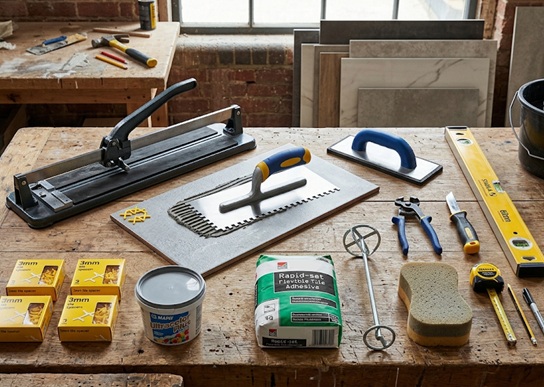
Different cuts call for different tools, so start with the tile material, thickness and the shape you need to achieve. You'll find a range of tiling tools and accessories for cutting and shaping tiles. For straight cuts on suitable wall and floor tiles, a tile scribe scores the surface before the tile is snapped along the line. For shaped or awkward cuts around pipes, switches, sills and other fittings, tile nippers can help.
Where the job needs holes for pipework or fittings, choose a tile and glass drill bit suited to the tile material and hole size: diamond-tipped bits handle harder materials such as porcelain and granite, while carbide bits suit standard ceramic tile and glass. Check the individual bit specification before drilling into a material it isn't suitable for, and mark hole positions accurately, since an off-centre hole is difficult to correct once the tile is fixed.
For harder materials, thicker tiles or larger-format work, a powered tile saw may be more suitable. For porcelain, wet cutting can reduce dust and help reduce chipping. Whatever the material, check that the cutter and blade are suitable before starting. Hiring can also make sense where specialist cutting equipment is only needed for one job.
Our Tool Hire offers tile saws for wet cutting and angled cuts.
Choose a spacer size to match the specified grout joint and the tile manufacturer's guidance. We stock tile spacers in a range of sizes and shapes, including cross spacers for standard tile layouts, so check the required joint width before ordering.
Tile trim comes in different depths and profiles, including round-edge and straight-edge options, with corner pieces available for some ranges. Choose a depth suited to the tile thickness and check whether matching corner pieces are available where the run includes internal or external corners.
Measure the full run of exposed edges to work out how much trim the job needs and reduce unnecessary joins.
A notched trowel spreads tile adhesive, and notch size affects how much adhesive is applied and the thickness of the bed it leaves behind, which in turn affects how well the tile bonds to the surface material. The right size depends on the tile, substrate and adhesive together, so check the tile and adhesive manufacturer's guidance rather than choosing by tile size alone.
A grout float works grout into the joints once the adhesive is ready for grouting. A grout sponge removes excess grout from the tile face during finishing, while a grout rake removes old or discoloured grout ahead of a re-grouting job, without needing to remove the tiles themselves. Follow the grout manufacturer's guidance on application, working time and cleaning.
Browse Travis Perkins' tile adhesives and grouts for the products needed for the fixing and grouting stages.
Run through these checkpoints before placing an order:
Tile material, dimensions and thickness
Wall or floor application
Type of cut required, including hole size and location where pipework or fittings need to pass through
Joint width and matching spacer size
Trim depth and profile
Adhesive type and matching trowel notch size
Grouting and finishing tools needed
Handling requirements for larger or heavier tiles, including whether lifting equipment is needed
Whether the job includes stripping old tiles and grout as well as fitting new ones
If the job involves porcelain tile specifically, our guide to cutting porcelain tile covers cutting methods and blade choice for wall and floor tiles as well as exterior slabs in more depth.