
Free Click & Collect
Within One Hour

Reading time: 7 minutes
Before comparing materials, it’s worth thinking about the practical needs of the job. A small garden patio may need a different type of slab to a busy outdoor dining area, pathway or larger landscaped space.
Key things to consider include expected foot traffic, the finished look the customer wants, slip resistance, cleaning and maintenance, installation time, budget, drainage and whether edging, jointing compound or sealant will be needed.
It is also important to think about the full build-up, not just the slab itself. A suitable sub-base, bedding layer and jointing method will all affect how well the paving performs over time.
Natural stone paving slabs are a popular choice for customers who want a traditional, high-quality finish. Because they are cut from natural materials, each slab can have slight differences in colour, texture and pattern, helping to create a more characterful patio or garden area.
Common types of natural stone paving include sandstone, limestone, slate and granite. Natural stone works well for patios, pathways, courtyards and landscaped areas where the customer wants a more natural finish.
Main benefits include natural colour variation, a durable finish when installed correctly, textured surface options and a long-lasting appearance with proper care. Natural stone can also weather over time, helping the paved area blend into the surrounding garden.
Natural stone can require more maintenance than some other paving materials. Depending on the stone type, it may need sealing to help protect against staining, moisture and general wear. Contractors should also mix slabs from different packs before laying to create a more even blend across the finished area.
Porcelain paving slabs are a popular option for customers looking for a clean, modern finish. They are manufactured rather than cut from natural stone, so they usually offer more consistent colour, sizing and surface finish.
Key benefits include a contemporary appearance, consistent colour and sizing, low water absorption, good stain resistance, easy cleaning and suitability for modern garden designs.
For projects where the customer wants a sharp, uniform finish, porcelain can be a strong choice. It can also be a good option for customers who want a low-maintenance patio or paved area.
Porcelain paving can be more difficult to cut than some other paving slabs, so the right tools and blades are important. It may also require a suitable slurry primer to help the slabs bond properly to the bedding layer. Because porcelain is less porous, contractors should follow the product guidance carefully to help avoid movement or poor adhesion.
Concrete paving slabs are a practical and cost-effective option for many landscaping and garden projects. They are available in a wide range of colours, sizes and finishes, including products designed to replicate the look of natural stone.
Concrete patio slabs are commonly used for patios, paths, utility areas and general garden paving where budget and availability are key considerations. Main benefits include good value, wide availability, practical sizing and a suitable finish for budget-conscious customers.
Concrete paving can be a good choice where the customer wants a smart, functional outdoor space without the higher cost of natural stone or porcelain. Some concrete slabs may be more prone to weathering, staining or colour changes over time, depending on the finish and level of maintenance.
The best paving material depends on the job, the customer’s expectations and the finish requirements. Natural stone paving suits projects where the customer wants character, colour variation and a traditional appearance. Porcelain paving slabs are a good option for modern patios where clean, consistent and low-maintenance finishes are important. Concrete paving slabs are often the most practical option for cost-conscious projects.
The paving slab is only one part of the installation. To achieve a strong and even finish, contractors should also plan the supporting materials and tools needed for the job.
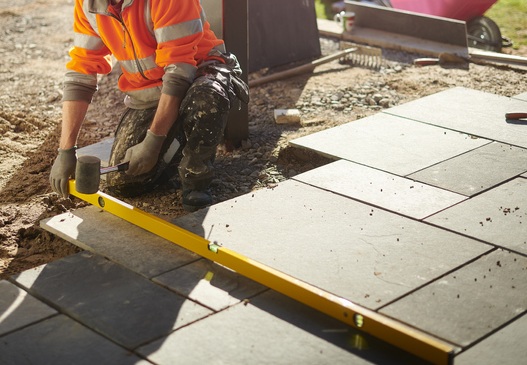
This may include sub-base material, sand and cement, jointing compound, sealant, edging stones or restraints, cutting tools, a spirit level, string line, rubber mallet, plate compactor and PPE.
A well-prepared sub-base helps reduce the risk of movement, sinking or uneven slabs. Edging can also help keep the paved area in place, especially on paths, patios and borders.
Whether paving slabs need sealing will depend on the material and the customer’s preference. Natural stone paving is often sealed to help protect against moisture, stains and weathering. Concrete paving may also benefit from sealing, depending on the finish and use of the area.
Porcelain paving slabs are usually lower maintenance, but customers may still want suitable cleaning or protection products depending on the location and level of use. Before applying any sealant, contractors should always check that it is suitable for the paving material being used.
A good paving installation depends on proper preparation as much as the slab choice. Common mistakes include choosing slabs based on appearance only, poor sub-base preparation, poor drainage, the wrong bedding or jointing method, unsuitable cutting tools and not allowing for edging or restraints.
Taking time to check the specification, ground conditions and installation method can help improve the final finish and reduce call-backs.
For a traditional or characterful finish, natural stone paving slabs are often a good choice. For a modern, low-maintenance patio, porcelain paving slabs may be more suitable. For practical garden paving on a tighter budget, concrete paving slabs can offer a strong and cost-effective solution.
The right choice will depend on the customer’s budget, property style, maintenance expectations and how the space will be used. Contractors should also plan the full installation, including sub-base, bedding, jointing, sealant, tools and edging.
By choosing the right paving slabs and preparing the area correctly, you can create a patio, path or garden space that looks good and performs well over time.
Porcelain paving slabs are usually lower maintenance and provide a more consistent modern finish. Concrete paving slabs are often more cost-effective and practical for budget-conscious projects. The better option depends on the budget and project requirements.
Natural stone paving can need more maintenance than porcelain, especially if the customer wants to protect the surface from staining or weathering. Sealing and regular cleaning can help keep natural stone paving looking its best.
The best patio slabs depend on the desired finish, budget and maintenance expectations. Natural stone works well for a traditional look, porcelain suits modern low-maintenance spaces, and concrete patio slabs are a practical option for many garden projects.
Yes, most paving slab installations need a suitable sub-base to provide stability and reduce the risk of movement or sinking. The exact build-up will depend on the ground conditions and project type.
Yes, porcelain paving slabs can be cut on site, but they are harder than many other paving materials. Contractors should use suitable cutting tools and blades designed for porcelain.
Natural stone, porcelain and concrete paving slabs can all be suitable for trade projects, but each one has different strengths. Natural stone offers character, porcelain provides a clean and low-maintenance finish, and concrete gives a practical option for many garden paving jobs.
For the best result, choose the slab type around the project needs, then plan the sub-base, bedding, jointing, edging and tools before work begins.